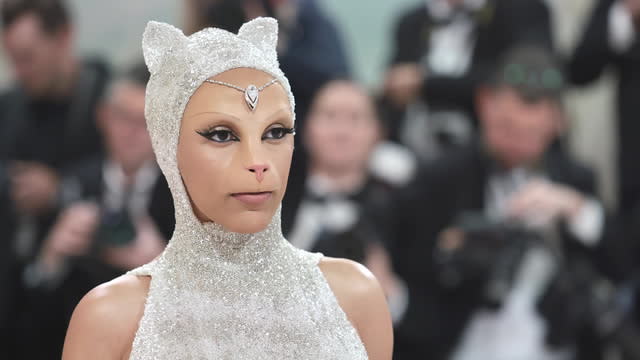
The Met Gala’s theme drops like a riddle wrapped in silk—always cryptic, often poetic, and never straightforward. This year’s ambiguous prompt has stylists scrambling not for answers, but for angles. “It’s not about literal interpretation,” says Marnie Becker, stylist for Florence Pugh and Regina King. “It’s about emotional resonance. About asking: What does this make you feel?” From sheer “naked” dresses that blur the line between body and fabric to tailored suits channeling the Mona Lisa’s enigmatic calm, the fashion world is dissecting the theme through a prism of art, provocation, and performance.
This isn't just couture—it's conceptual storytelling on a global stage. And behind every look, there’s a stylist translating ambiguity into audacity.
Why Ambiguity Fuels the
Most Memorable Met Gala Looks
The Met Gala thrives on vagueness. Past themes like “Heavenly Bodies” or “Camp: Notes on Fashion” left room for wide interpretation—and sparked some of the most talked-about red carpet moments in history. When the directive isn’t prescriptive, creativity explodes.
Take 2019’s “Camp” theme. Most expected glitter and flamboyance. But Harry Styles, styled by Harry Lambert, wore a black satin jumpsuit with a feathered collar—understated, but dripping with theatrical tension. It wasn’t loud; it was felt. That’s the power of ambiguity: it rewards nuance over noise.
This year, stylists aren’t asking, “What should we wear?” They’re asking, “What story can fashion tell under this theme?” The answers span from literal art references—Leonardo da Vinci’s brushstrokes rendered in embroidery—to conceptual statements, like the illusion of invisibility via nude mesh and strategic beading.
The “Naked Dress” Debate: Vulnerability or Vanity?
The “naked dress”—sheer fabric layered over nude underlining—has become a recurring Met Gala motif. Rihanna in Adam Selman, Kim Kardashian in Givenchy, Zendaya in Atelier Versace: each turned the illusion of undress into a power play.
But this year, stylists are re-evaluating the trope. “It’s not enough to just be sheer,” says Jason Bolden, who dressed Marsai Martin and Jonathan Majors. “The question now is: What does the nakedness represent? Is it liberation? Exposure? A commentary on authenticity?”
Some are leaning into texture. One look in development uses layers of hand-cut tulle, dyed to match skin tones across a spectrum, symbolizing visibility and erasure in one breath. Another uses illusion panels lined with micro-embroidered quotes—personal mantras hidden in plain sight.
The risk? Being misread as sensational rather than symbolic. “Too many stylists still use the naked dress as a shortcut to attention,” says stylist Jamie Mizrahi. “But on the Met Gala carpet, you have eight seconds to communicate depth. If your message is just ‘look at me,’ you’ve already lost.”
Mona Lisa as Muse: Why the Icon Inspires Suits, Not Gowns
Perhaps the most unexpected trend emerging from this year’s theme is the “Mona Lisa suit.” Not a literal depiction, but a sartorial embodiment of her essence: composed, knowing, timeless.

Stylist Lorenzo Posocco, who works with Paul Mescal and Florence Welch, is crafting a look inspired by her gaze. “She’s not smiling. She’s observing. There’s power in stillness.” His design? A charcoal wool three-piece with a subtle gradient lapel mimicking the sfumato technique—da Vinci’s soft blending of light and shadow. The shirt underneath features a laser-etched print of her eyes, visible only in certain light.
“It’s menswear, but it’s not masculine,” says Posocco. “It’s neutral. It’s about containment. About what you choose to reveal.”
Other stylists are taking similar routes: structured silhouettes, minimal embellishment, and an intentional lack of flash. One female client is wearing a pantsuit with a high-neck pleated bodice, her hair pulled back in a Renaissance braid. No jewels. No drama. Just precision.
This shift matters. For years, the Met Gala celebrated extravagance. Now, restraint is becoming a statement.
Art Imitating Life: When the Outfit Is the Installation
Some stylists are treating the Met Gala not as a red carpet, but as a gallery opening. One look in production for a performance artist client involves a dress made entirely of deconstructed pages from art history books—hand-painted, layered, and sealed with resin. “It’s fragile,” the stylist admits. “It might not survive the night. But that’s part of the point.”
Another concept, still in early sketches, features a gown with embedded micro-LEDs programmed to shift colors based on the wearer’s heart rate. “The theme is about inner and outer expression,” says the designer. “Why not make the dress respond to emotion in real time?”
These aren't wearable clothes in the traditional sense. They’re fashion as performance art. And for stylists, the challenge is balancing spectacle with wearability.
“Clients still have to walk, sit, eat, and breathe,” says Becker. “You can’t let the concept suffocate the person.”
The Hidden Work Behind the Theme Breakdown
What the public sees is the final look. What stylists endure is weeks of research, mood boards, fabric sourcing, and negotiation.
First comes the decoding phase. “We dissect the theme like a thesis,” says Bolden. “We pull historical references, psychological angles, even color theory.” From there, they build a narrative arc: Who is the client in this moment? What role are they playing?
Then comes collaboration—designers, seamstresses, wig artists, even lighting consultants. “One look might go through 14 mock-ups,” says Mizrahi. “And the final version? Maybe 70% different from the sketch.”
Clients often want to push boundaries—sometimes too far. “I had one client who wanted to arrive in a glass box, like the Mona Lisa,” laughs Posocco. “We compromised: a headpiece with a miniature display case. She carried a tiny replica of herself inside.”
These behind-the-scenes choices define the final impact. The best looks aren’t just striking—they feel inevitable.
Bridging Eras: How Stylists Mix Historical Accuracy
with Modern Edge
The theme’s ambiguity invites time-bending designs. But blending Renaissance aesthetics with modern fashion is a tightrope walk.
Too literal? Costumey. Too abstract? Confusing.
Stylists are finding balance through material innovation. One look uses corsetry inspired by 16th-century Italy, but constructed from recycled carbon fiber—rigid, lightweight, and sustainable. Another combines a ruff collar with augmented reality: when viewed through a Met-provided app, the collar animates into a digital halo.
Color is another tool. While da Vinci worked in earth tones, modern interpretations aren’t bound by palette. “I’m using a deep cobalt blue,” says a stylist working with a nonbinary performer. “It’s not period-accurate, but it evokes the same depth as his skies.”

The key? Anchor one element in history—the cut, the silhouette, the texture—then disrupt the rest. That tension is where fashion becomes conversation.
The Risk of Over-Interpretation
With so much room to interpret, some stylists fall into the trap of overcomplicating.
“I’ve seen mood boards with 87 layers of meaning,” says Becker. “By the end, the look doesn’t communicate anything.”
The danger is creating fashion that’s smart but silent—rich in concept, poor in connection. “People don’t remember the thesis statement,” says Bolden. “They remember how it made them feel.”
A standout look from a past gala: a simple white column dress with a single, cracked porcelain panel down the front. No explanation needed. It spoke of fragility, repair, and beauty in imperfection. It wasn’t loud. It lingered.
This year, the most powerful looks may be the quietest—the ones that trust the viewer to lean in, not shout from across the room.
Final Countdown: Dress Rehearsals and Last-Minute Pivots
In the 72 hours before the Met Gala, everything can change.
A fabric tears. A client has a last-minute fear of feathers. A stylist sees a competitor’s leaked look and panics.
“One year,” says Mizrahi, “we switched the entire concept at midnight. The original look was gold—it tested too ‘rich aunt at a wedding.’ We went monochrome black, added chain detailing, and called it ‘Gothic Archive.’ Saved it.”
Rehearsals are intense. Models walk in heels, test sitting positions, even simulate eating. “We watch for flash points,” says Bolden. “Where does the gown catch? Where does the headpiece block vision?”
And always, there’s the weather. Rain can destroy a look made of paper, silk, or electronics. “We have backup plans. Always.”
But the best stylists don’t just plan—they adapt.
When the Met Gala curtain rises, the red carpet won’t just showcase fashion. It’ll reveal how stylists translate ambiguity into art. From naked dresses that whisper vulnerability to Mona Lisa-inspired suits radiating quiet power, the night belongs to those who understand: the most profound statements aren’t shouted. They’re felt.
If you’re crafting a look—on the carpet or in life—ask not what the theme demands, but what it allows you to reveal.
FAQ
What does the Met Gala’s ambiguous theme mean for stylists? It gives them creative freedom but demands deeper conceptual thinking—balancing artistry with wearability and message.
Are naked dresses still a Met Gala staple? Yes, but they’re evolving. Stylists now use sheer designs to convey vulnerability, identity, or commentary, not just shock value.
Why are some stylists designing Mona Lisa-inspired suits? They’re capturing her essence—mystery, composure, timelessness—through tailored silhouettes, restrained palettes, and subtle artistic details.
How do stylists avoid over-interpreting the theme? By focusing on emotional impact over intellectual complexity. The best looks communicate instantly, even if layered in meaning.
What’s the biggest challenge in preparing for the Met Gala? Coordination. A single look can involve dozens of people, multiple prototypes, and last-minute changes due to client, weather, or competition.
Can everyday fashion draw from Met Gala styling? Absolutely. The principle of dressing with intention—choosing pieces that express identity or mood—applies at any scale.
How far in advance do stylists start working on Met Gala looks? Typically 4 to 6 months, including research, design, fittings, and contingency planning.
FAQ
What should you look for in From Naked Dresses to Mona Lisa Suits: Stylists Decode the Met Gala's Va? Focus on relevance, practical value, and how well the solution matches real user intent.
Is From Naked Dresses to Mona Lisa Suits: Stylists Decode the Met Gala's Va suitable for beginners? That depends on the workflow, but a clear step-by-step approach usually makes it easier to start.
How do you compare options around From Naked Dresses to Mona Lisa Suits: Stylists Decode the Met Gala's Va? Compare features, trust signals, limitations, pricing, and ease of implementation.
What mistakes should you avoid? Avoid generic choices, weak validation, and decisions based only on marketing claims.
What is the next best step? Shortlist the most relevant options, validate them quickly, and refine from real-world results.


/cities-skylines-5a0ef1eabeba3300375673ba.png)