Construction sites in the UK move fast. Deadlines tighten, weather shifts, and new subcontractors arrive mid-week. In environments like these, formal safety training isn’t enough. You need quick, focused, and relevant conversations—delivered at the right time, in the right place. That’s where toolbox talks come in.
Yet too many UK site managers treat them as a box-ticking exercise. A rushed five-minute speech about “working at height” copied verbatim from a generic PDF, delivered to disengaged teams. It’s no surprise that when incidents happen, someone later says, “We did a talk on that last month.”
Effective toolbox talks aren’t about compliance. They’re about connection. Clarity. Retention. And they start with strong, relatable examples.
This guide delivers practical, UK-specific toolbox talk examples used on real sites—from scaffolding safety and electrical hazards to lone working and manual handling. More importantly, it shows how to deliver them so they stick.
What Are Toolbox Talks and Why Do They Matter in the UK?
A toolbox talk is a short safety meeting—usually 5 to 15 minutes—held at the worksite to discuss a specific hazard, task, or change in conditions. Unlike formal risk assessments or method statements, they are informal, interactive, and timely.
In the UK, they are a cornerstone of HSE (Health and Safety Executive) best practice. While not legally required as standalone documents, they support legal compliance under the Management of Health and Safety at Work Regulations 1999 and CDM (Construction Design and Management) 2015. These laws demand that risks are communicated effectively to workers—something toolbox talks do well when done right.
The best talks are:
- Task-specific: Tied to what the team is doing today
- Site-relevant: Address actual conditions (e.g., “The trench on Plot B has unstable edges”)
- Interactive: Invite questions, stories, or observations from operatives
Without this focus, they become noise. With it, they prevent accidents.
Key Elements of an Effective Toolbox Talk Before diving into examples, understand the framework that makes them work. A strong UK toolbox talk includes:
- Topic Relevance – Is this something the team actually faces right now?
- Clear Objective – What should workers know or do differently after the talk?
- Engagement Method – Are you asking questions, showing visuals, or referencing past incidents?
- Sign-Off – Do attendees sign to confirm attendance and understanding?
- Follow-Up – Will you check if the safety message was applied later in the shift?
Common mistakes that weaken effectiveness:
- Repeating the same generic topic monthly
- Failing to adapt to weather, staffing, or task changes
- Not encouraging worker input
- Skipping sign-in sheets or record-keeping
The HSE doesn’t require signatures, but they’re crucial for your internal audit trail—especially if an incident occurs.
Real-World Toolbox Talk Examples Used on UK Sites
These are drawn from actual briefings used across commercial and civil engineering projects in the UK. Adapt them to your site, but keep the tone conversational and grounded.
Example 1: Working at Height – Ladder Safety
Hazard: Falls from height account for nearly 30% of construction fatalities in the UK (HSE, 2023). Ladders are often misused.
Talk Points: - Ladders are for light-duty tasks only—never for extended work - Always maintain three points of contact - Check ladder condition: no missing rungs, damaged stiles, or loose feet - Angle: 75 degrees (1m out for every 4m up) - Secure top and bottom; never lean over the side
Interactive Prompt: “Who’s seen a ladder used unsafely this week? What did you do?”
Follow-Up: Supervisor checks ladder use during morning walk-around.
Example 2: Excavation & Trench Safety
Hazard: Ground collapse, utility strikes, and falls into trenches.
Talk Points: - Never enter a trench deeper than 1.2m without trench support - Confirm Cable Avoidance Tool (CAT) scan was done before digging - Store spoil and materials at least 1m from edge - Check for water ingress—pumping may be needed - Emergency ladder every 10m in trench
Interactive Prompt: “Point to the nearest trench. Is it properly supported and signed?”
Follow-Up: Review permit-to-dig logs and inspection tags.
Example 3: Manual Handling – Reducing Back Injuries
Hazard: Over 40% of construction musculoskeletal injuries involve manual handling (HSE).
Talk Points: - Assess: Can you avoid lifting? Use a trolley or hoist? - Plan: Clear path? Rest points? Team lift needed? - Posture: Keep back straight, bend knees, load close - Team lifts: One person leads the lift (“Up on three…”)
Interactive Prompt: “Show me how you’d lift a 25kg sack safely.” (Encourage demonstration)
Follow-Up: Check availability of handling aids on site.
Example 4: Electrical Safety Near Overhead Lines
Hazard: Contact with 11kV+ overhead lines causes fatalities annually.
Talk Points: - Know location of all overhead lines—marked on site plan - Minimum 6m clearance for machinery and materials - Stop work if crane or MEWP operation near lines - Confirm de-energising or line diversion if work must be closer
Interactive Prompt: “Where’s the nearest overhead line? Could the excavator swing near it?”
Follow-Up: Verify exclusion zones with spotters during high-risk lifts.
Example 5: Cold Weather Working
Hazard: Slips, reduced dexterity, and hypothermia risk in UK winters.
Talk Points: - Wear thermal layers, waterproof outerwear, and grippy boots - Take frequent warm-up breaks - Watch for frost on scaffolding, ladders, or walkways - Hydrate—cold air dries you out - Report numbness, shivering, or confusion
Interactive Prompt: “What’s one thing you’ve changed in your kit for winter?”
Follow-Up: Check welfare units are heated and stocked.
How to Deliver a Toolbox Talk That Workers Actually Listen To It’s not enough to read from a script. Engagement is everything.
1. Deliver at the Right Time and Place Hold the talk on site, before work starts, and where the task happens. A talk on scaffolding safety should happen at the scaffold—not in the portakabin.
2. Keep It Short and Focused Stick to one topic. Don’t cram in “PPE, fire safety, and noise” in 10 minutes. Pick the biggest risk today.
3. Use Visuals or Props Bring a damaged harness, a frost-covered glove, or a section of shored trench. Visuals increase retention by up to 70% (HSE research).
4. Ask Open Questions Instead of “Do you wear gloves?” try “What’s stopped you from wearing gloves in the past?” You’ll uncover real barriers.
5. Rotate Who Leads Let a site worker lead occasionally. It builds ownership and often brings up issues managers miss.
When to Hold a Toolbox Talk on UK Sites
Timing matters. These are non-negotiable triggers for a talk:
![How to Lead a Work Area Housekeeping Toolbox Talk [+ Template]](https://cdn.prod.website-files.com/62294553e9aeea20d15d7bc2/63f784ce55a35a80a1ec43f1_1.webp)
- Start of a new project or phase
- Introduction of new equipment or method
- Change in weather (e.g., high winds, ice)
- After a near-miss or incident
- New staff or subcontractors on site
- Weekly refresh on high-risk tasks
One London-based contractor mandates toolbox talks every Monday and after any permit change—resulting in a 40% drop in reportable incidents over 18 months.
Common Pitfalls That Make Toolbox Talks Ineffective
Even with good intentions, teams fall into traps.
- Repetition without relevance: Doing “slips and trips” every week, regardless of conditions
- No follow-through: Workers say “we never check if it’s done later”
- Top-down delivery: Supervisor lectures while team stares at boots
- Poor documentation: No attendance records or topic logs
Fix this by auditing your talks quarterly. Ask workers: “Did last week’s talk help you stay safe? How?”
One Midlands contractor started filming short talks and sharing them in team WhatsApp groups. Retention improved—and so did accountability.
Integrating Toolbox Talks Into Your UK Safety Culture
The best sites don’t see toolbox talks as standalone events. They’re part of a broader safety rhythm:
- Daily: 5-10 min toolbox talk at site kick-off
- Weekly: Review of last week’s topics and incident trends
- Monthly: Audit of talk quality, attendance, and follow-up actions
Use your site’s accident book, near-miss reports, and supervisor logs to inform topics. If there were three trips on uneven ground last week, that’s your talk.
Also, link them to other systems: - Update risk assessments if new hazards emerge - Feed findings into site safety tours - Share anonymised lessons in company newsletters
This turns toolbox talks from admin into action.
Toolbox talks work when they’re real, responsive, and respected. The best examples in the UK don’t come from generic templates. They come from supervisors who observe, listen, and speak plainly about what could go wrong—and how to stop it.
Use the examples above as a starting point, but make them your own. Tailor the language, add local details, and bring in your team’s experience. That’s how you turn a routine briefing into a life-saving conversation.
Start tomorrow: pick one high-risk task, gather your crew on site, and ask one simple question. “What’s the biggest danger we face today—and how do we beat it?” That’s the heart of a real toolbox talk.
FAQ
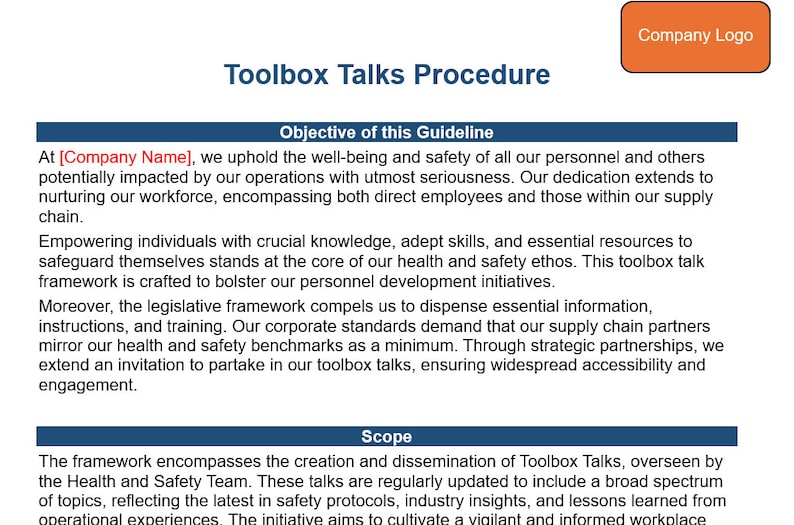
What should be included in a UK toolbox talk? A clear topic, hazard explanation, safe work practices, worker interaction, and attendance record. It should be brief, site-specific, and actionable.
How often should toolbox talks be held in the UK? At least weekly, or whenever there’s a new risk, task, team member, or environmental change. High-risk sites often do them daily.
Are toolbox talks a legal requirement in the UK? Not explicitly, but under CDM and HSE regulations, you must communicate risks effectively—toolbox talks are a recognised way to do this.
Who can deliver a toolbox talk on a UK construction site? Supervisors, site managers, or competent workers. The key is knowledge of the topic and ability to engage the team.
Do you need to record toolbox talks? Yes. While not legally mandated, documented talks (with sign-ins) prove due diligence if inspected by HSE or during incident investigations.
Can toolbox talks be delivered digitally on UK sites? Yes—via tablets or apps—but only if all attendees are present and engaged. Avoid sending them as emails or videos without discussion.
What’s the difference between a toolbox talk and a safety induction? Inductions are general, for new site entrants. Toolbox talks are specific, for active teams, focused on immediate tasks and hazards.
FAQ
What should you look for in Toolbox Talk Examples UK: Practical Safety Briefings for Sites? Focus on relevance, practical value, and how well the solution matches real user intent.
Is Toolbox Talk Examples UK: Practical Safety Briefings for Sites suitable for beginners? That depends on the workflow, but a clear step-by-step approach usually makes it easier to start.
How do you compare options around Toolbox Talk Examples UK: Practical Safety Briefings for Sites? Compare features, trust signals, limitations, pricing, and ease of implementation.
What mistakes should you avoid? Avoid generic choices, weak validation, and decisions based only on marketing claims.
What is the next best step? Shortlist the most relevant options, validate them quickly, and refine from real-world results.